Once you have seen the property you want, you are ready to reserve it, sign the contract and move forward. Then your lawyer tells you nothing happens without your NIE, and you realise you have no idea whether you have to fly to Spain, queue at the London consulate, or if there is a way to handle it from home without moving from your sofa.
The NIE (Número de Identidad de Extranjero) is compulsory for any foreigner buying property in Spain. There are three legitimate ways to obtain it, and choosing the right one saves you weeks and, in many cases, unnecessary trips. Most of the British and Northern European clients we work with never set foot in Spain to get their NIE. They sign a power of attorney at home and we take care of everything on the ground here.
What is a NIE and why you cannot buy property in Spain without it
The NIE is your tax identification number as a foreigner in Spain. Every legal, fiscal or financial action that involves you and the Spanish administration requires an NIE attached to it. Buying property is one of those actions.
The number itself is nine characters long. It starts with a letter (X, Y or Z), followed by seven digits, and ends with a control letter. Once issued, it stays with you for life. The number does not expire. The paper certificate you receive may carry an issue date, and some notaries have the habit of asking for a recent copy, but that is custom rather than law.
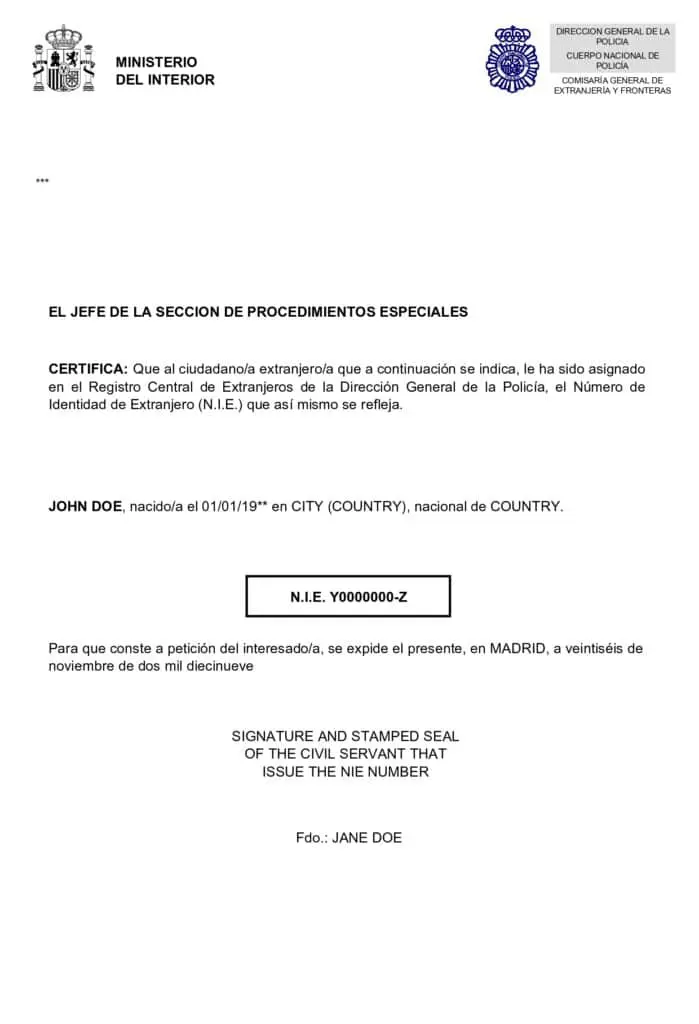
British buyers often confuse the NIE with the TIE (Tarjeta de Identidad de Extranjero), and the distinction matters.
The NIE is a number you need to buy, own or inherit property, open a Spanish bank account or pay Spanish taxes. The TIE is the physical residence card that British nationals living in Spain full-time have needed since Brexit. If you are buying a second home and continuing to live in the UK, the NIE is what you need.
If you plan to relocate here, you will eventually need both.
¿When do you need the NIE in the property purchase process?
A common misunderstanding is that the NIE only becomes necessary at completion. In practice, it becomes essential much earlier.
The typical purchase in Spain follows a sequence. First, a reservation agreement to take the property off the market. Then the contrato de arras (deposit contract), which usually commits ten per cent of the price and is legally binding on both sides. Then, if you need a mortgage, the bank process. Finally, the signing of the escritura pública at the notary, followed by registration in the Land Registry and the payment of transfer taxes.
The reservation stage can technically be signed without an NIE, since it commits little more than a small holding deposit. From the contrato de arras onwards, you need it. The notary will not authorise the escritura without every buyer having their own NIE, and no Spanish bank will let you open the account you need to transfer completion funds without one either.
If you want the full picture of the purchase timeline, we cover it in our step-by-step guide to the conveyancing process for non-residents. The practical takeaway here is straightforward. Get the NIE moving the moment you are seriously interested in a property, not once you have already committed.
The three ways to get your NIE and which one fits you
You can apply in Spain in person, at a Spanish Consulate in your country, or through a Power of Attorney handled by your lawyer here. All three are legally equivalent. What changes is time, cost and how much travelling you have to do.
Applying in person in Spain
You book an appointment through the sede electrónica of the Spanish administration and attend either a Policía Nacional station with a foreigners’ unit or an Oficina de Extranjeros. You bring your passport, a completed EX-15 form (in Spanish), documentation showing why you need the NIE, typically the signed reservation contract, and the tasa 790-012, currently €9.84, paid at any Spanish bank or online.
Alicante and Torrevieja are usually more manageable than Madrid or Barcelona in terms of appointment availability.
Applying at the Spanish Consulate in your country
If you would rather sort it out before travelling, the Spanish Consulate covering your area handles the application. In the UK, the Consulate General in London is the main port of call. In-person attendance is compulsory. There is no online-only route.
You submit the same EX-15 form (still in Spanish, even at a UK consulate), your original passport with a photocopy, evidence of the reason for the application, and the consular fee. In London the fee sits at around £8.65, though it varies slightly with the exchange rate, as the underlying charge is denominated in euros.
Realistic timing depends heavily on the consulate. In London, expect anywhere from three weeks to a couple of months from booking your appointment to holding the certificate.
Applying through a Power of Attorney from your home country
The third route is the one most of our international clients use. You sign a Power of Attorney at a notary in your country authorising us to obtain the NIE on your behalf. That document then needs to be legalised with the Hague Apostille and posted to us. Once we have it, we book the appointment, present the paperwork and collect the certificate.
Realistic timing from receipt of the apostilled POA is one to three weeks, depending on appointment availability at that moment. It is not the 24 to 72 hours you sometimes read on estate agency blogs. It is quicker than the consulate route, and it means you never travel just for a stamp.
We do this constantly as part of the wider service. If you are looking for a lawyer for buying your property in Torrevieja or Orihuela Costa, the NIE is one of the first things we take off your plate.
| Route | Where | Realistic timing | Cost | When it makes sense |
|---|---|---|---|---|
| In person in Spain | Policía Nacional or Oficina de Extranjeros | Same day to 1 week | €9.84 | You are already visiting |
| Spanish Consulate abroad | Consulate covering your area, e.g. London | 3 weeks to 2 months | £8.65 (London) | You have time and prefer no third party |
| Power of Attorney | Handled by your Spanish lawyer | 1 to 3 weeks after apostilled POA arrives | Local notary and apostille fees, plus lawyer’s fee | You want no travel or have a tight completion date |
Documents you need and how the fee works
Regardless of which route you use, the documentation is broadly the same.
- The EX-15 form, completed in Spanish. Fill it out but do not sign it until you are in front of the officer, or your lawyer is submitting it on your behalf.
- Your original passport, plus a full photocopy of every used page. This is a common trip-up. Copying only the ID page is not enough.
- Proof of the reason for the application. A signed reservation contract or contrato de arras is the standard document. For international buyers, a letter from us confirming the purchase in progress is also accepted.
- Payment of the tasa 790-012, currently €9.84 in Spain. At the London Consulate the equivalent fee is around £8.65, adjusted periodically for exchange rates.
- If you are applying through Power of Attorney, the POA itself, legalised with the Hague Apostille and, in some cases, with a sworn translation into Spanish.
You may have seen higher fee figures quoted elsewhere, sometimes €15 or €20. Those tend to reflect service charges bundled by third parties rather than the actual government fee, which is fixed and public. Ask for a breakdown if in doubt.
Common mistakes that get NIE applications rejected
Rejection at the counter happens more often than most people expect, and it is almost always down to paperwork rather than anything substantive. These are the cases we see repeatedly.
- The name on the EX-15 form does not match the passport exactly. Middle names, married names and diacritics all matter.
- The reason for the application is stated in vague terms. Writing “thinking of buying a property” will not do. You need a specific document attached, whether that is a reservation contract, an offer accepted in writing or a lawyer’s letter on file.
- The passport photocopy is incomplete. Every used page must be copied, not only the photo page.
- The tasa has been paid through the wrong route. Online payment through the tax agency portal is valid, but keep the receipt. Some officers ask specifically for the stamped bank copy.
- The Power of Attorney has been signed but not apostilled. Without the Hague Apostille, the POA has no effect for administrative purposes in Spain.
Each of these is trivial to fix in advance and expensive to fix afterwards, since you may lose the appointment slot and be sent to the back of the queue for weeks.
What happens after you have your NIE
Getting the NIE is a milestone, not the finish line. Once you have it, three things usually happen next.
You register with the Spanish tax authorities, typically through the Modelo 030, so you appear as a taxpayer identified with your NIE. Your lawyer files this for you. You then open a Spanish bank account, since you will need one to transfer the completion funds and to pay Spanish taxes and utilities in the future. And when the notary date is fixed, you sign the escritura, at which point your NIE gets recorded on the deed and passed to the Land Registry.
To see how the NIE fits into the broader picture, our full conveyancing walkthrough for non-residents lays out the sequence from reservation to registration, including the taxes, the notary appointment and the post-completion steps.
Frequently asked questions
Does my NIE expire?
No. The number itself is issued for life. The paper certificate may carry an issue date, and some Spanish notaries still ask for a certificate less than three months old out of habit rather than legal requirement. If that happens, we can request a fresh copy quickly.
Can my spouse and I share a NIE?
No. Every person listed on the escritura needs their own NIE. If you are buying jointly, you both apply. And if you are both using Power of Attorney, you both sign a POA in your country.
Do I still need a NIE if I am paying cash and not opening a Spanish bank account?
Yes. The NIE is a legal requirement for appearing on the escritura, not a banking one. Whether the funds arrive by bank transfer, banker’s draft or cash, the notary cannot sign the deed without every buyer’s NIE.
How long does the Power of Attorney route actually take?
Between one and three weeks from the moment we receive the apostilled POA. The main variable is appointment availability at the local office at that particular time. Estate agency blogs sometimes advertise 48 hours. We would rather quote you honestly and beat the estimate than promise something we cannot always deliver.
Do British buyers need a NIE or a TIE?
It depends on your plans. If you are buying a second home and continuing to live in the UK, the NIE is enough. If you plan to move to Spain and become a resident, you will apply for residency first and be issued a TIE, which is a physical card carrying your NIE number. For the property purchase itself, the NIE is what the notary asks for.
Handling the NIE from wherever you are
Sorting the NIE from abroad is one of the smaller decisions in a property purchase, but it sets the tone for the rest of the process. Handle it early and through the right route, and everything downstream (arras, mortgage, notary, taxes) moves smoothly. Leave it late or take the wrong route, and you can lose weeks and, occasionally, deals.
If you are already in the middle of a purchase in Torrevieja, Orihuela Costa or the surrounding area and want us to handle the NIE alongside the rest, message us on WhatsApp or book a 15-minute call. We will tell you honestly which of the three routes fits your timeline before you spend a penny on anything.